
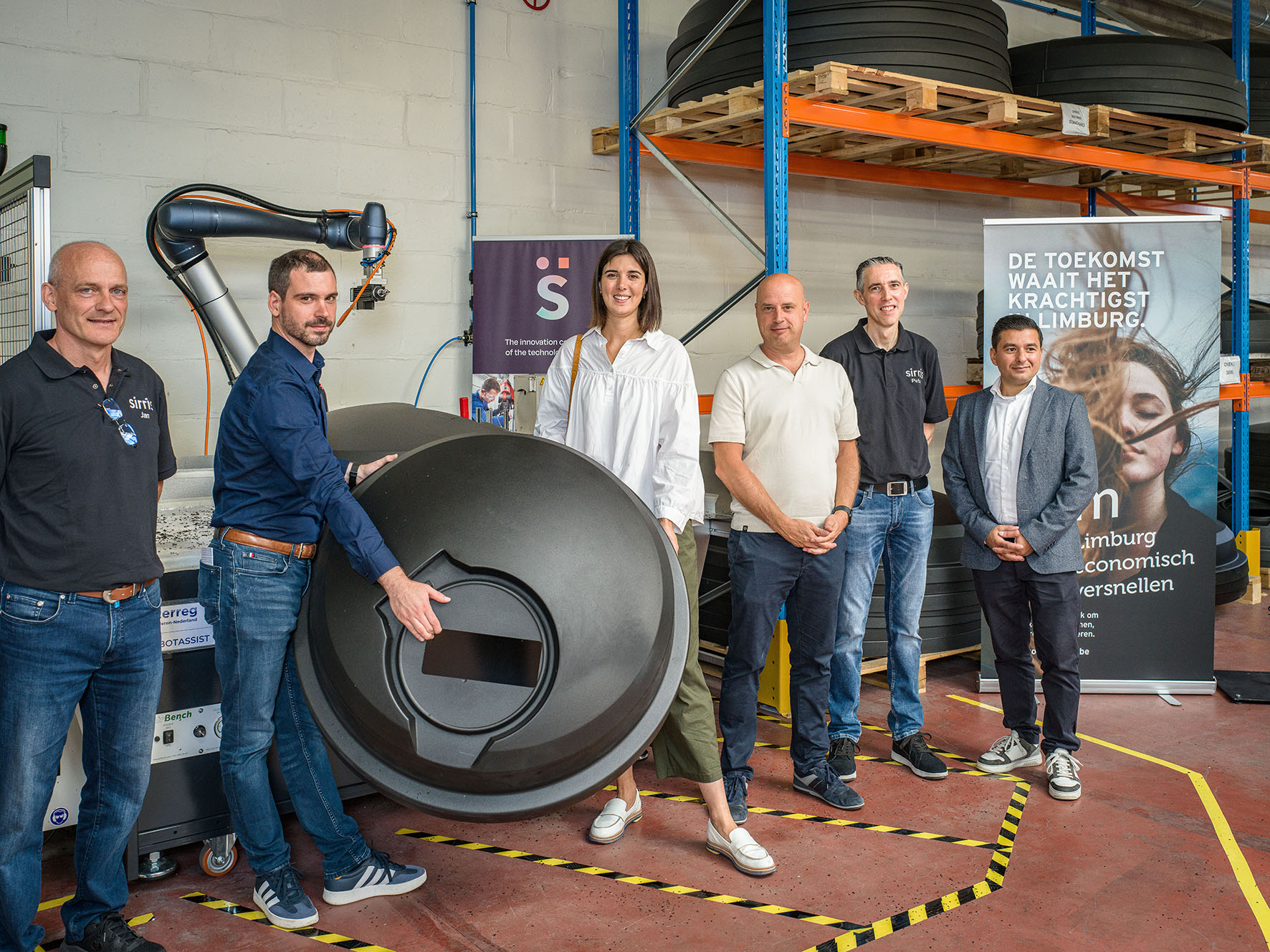
Traflux tests mobile cobot for finishing plastic lids
HOUTHALEN-HELCHTEREN – This month, Traflux, a manufacturer of waste containers and specialist in waste collection, has a mobile robotic arm working alongside employees on the production floor. For several weeks, it is taking over part of the heavy, precision work: removing sharp edges from plastic components, known in technical jargon as ‘deburring’. The test is part of the COBOTASSIST project of Interreg Flanders-Netherlands. Knowledge and research centre Sirris is responsible for the technical guidance, while economic development agency POM Limburg supports the participating Flemish SMEs.
Traflux manufactures waste containers ranging from 100 to 5,000 litres, using a technique known as rotational moulding. Openings have to be made in the plastic lids of these containers. Today, this is still done by hand: first milling, followed by smoothing the edges. It is precision work, physically demanding, and one wrong move can immediately render a component unusable.
This month, Traflux is testing whether a cobot can take over this work, allowing employees to focus on tasks with higher added value. The robot is simply positioned among the other machines on the production floor, in the midst of the factory’s normal operations.
“Above all, we wanted to experience how such a cobot behaves in a real production environment,” says Maarten Conings, Production Manager at Traflux. “We have allocated a budget of 500,000 euros for automation and digitalisation in 2027. This experience helps us make targeted choices, with a real impact on quality and lead time.”
Not just a problem at Traflux
Traflux is not the only company struggling with this issue. More than 7 out of 10 products made from steel or plastic still require finishing after production: sanding, polishing or deburring to remove sharp edges and irregularities. On average, this accounts for one fifth of production time and up to 15 per cent of the cost price. Yet today, this work is still done by hand in 8 out of 10 cases, precisely the kind of job for which it is becoming increasingly difficult to find staff.
For many manufacturing companies, this is a difficult balancing act. Customers expect products that are finished to a high standard, customised, and yet delivered quickly and at low cost. It is precisely this final, manual step in the process that makes it difficult to meet all these expectations at the same time.
Testing without having to buy immediately
Cobots are well suited to this type of work. Unlike traditional industrial robots, they can ‘feel’ how much force they are applying, which is useful for sanding, polishing or deburring. Safety must, however, always be guaranteed, based on a risk assessment and appropriate measures.
Through the COBOTASSIST voucher programme, SMEs in Flanders and the Netherlands can test such a mobile cobot in their own factory for several weeks, with support from the project team. This allows them to see for themselves whether the technology works for them, without having to buy a machine straight away. Traflux is the first company to carry out such a voucher programme.
“Cobots can be an interesting addition for tasks that are heavy, repetitive or ergonomically demanding,” says Jan Kempeneers, Principal Engineer Smart Manufacturing at Sirris. “Nevertheless, the step towards automation is still a big one for many SMEs. By allowing companies to test the technology first in their own production environment, they gain a realistic picture of both the possibilities and the points requiring attention.”
Getting Limburg companies on board
Together with the project partners, and through workshops and training courses, POM Limburg is working to familiarise Limburg manufacturing companies with cobot technology.
“Many companies see the possibilities of automation but do not really know where to start,” says Tom Vandeput, Deputy for Economy and Chairman of POM Limburg. “We want to remove that barrier by providing Limburg companies with concrete support to get started, so that automation does not remain something distant and inaccessible for the local manufacturing industry.”
COBOTASSIST is an Interreg Flanders-Netherlands project involving Sirris, Fontys, Breda Robotics, SyntraPXL, POM Limburg, High Tech NL and Avans.