
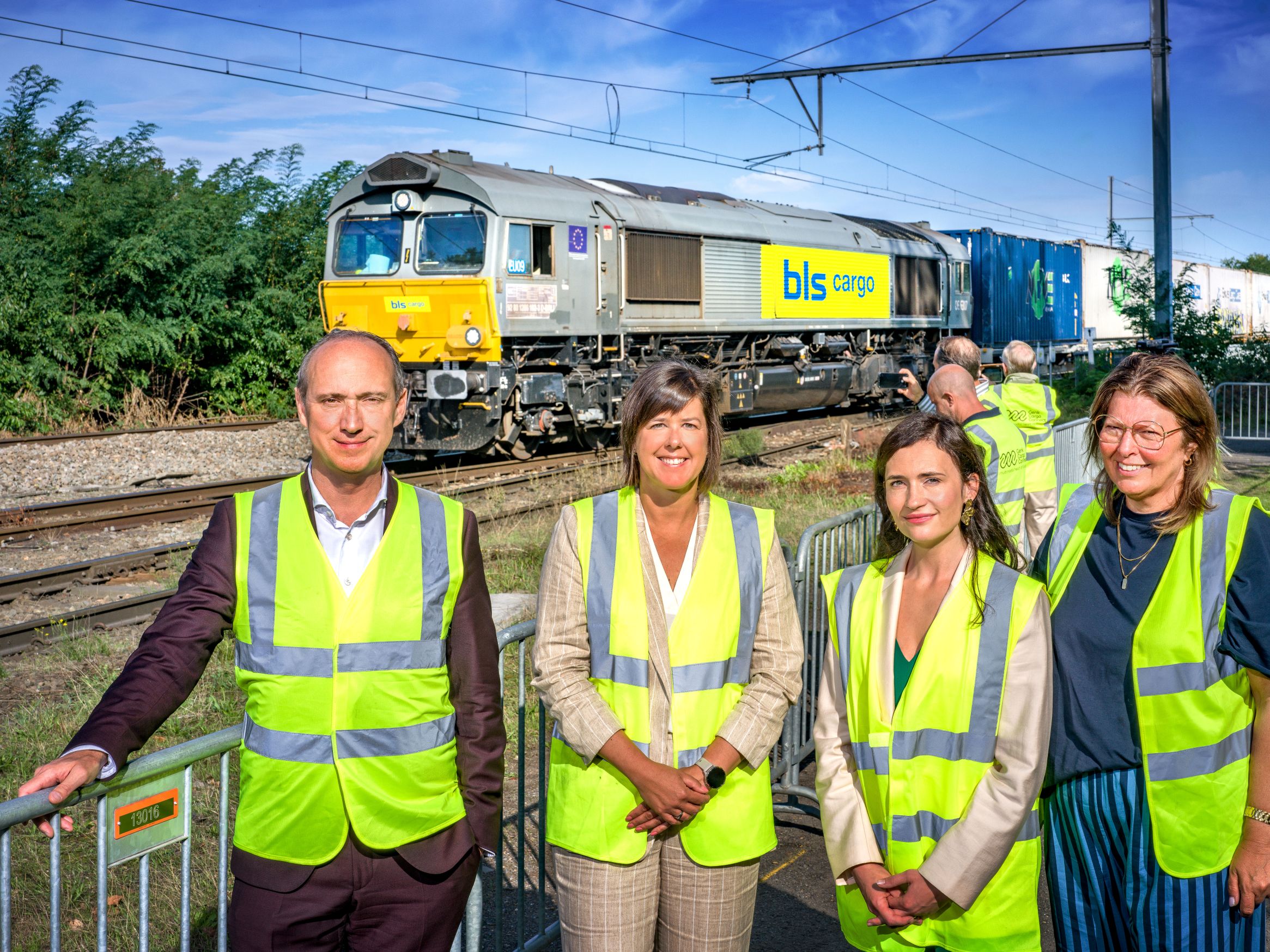
SALKturbo support enables electric rail access to Genk Cargo Connect
First inland terminal in Belgium with electric rail access
GENK – Genk Cargo Connect is installing electric rail access to its terminal, making it the first inland terminal in Belgium accessible to electric freight trains. The project is receiving SALKturbo support through the European ERDF programme.
The L21C railway line, to which Genk Cargo Connect is connected, was already electrified in 2022. Only the final section leading to the terminal itself – the branch line along which trains actually enter the terminal – had not yet been equipped with overhead lines. As a result, freight trains have to switch to a diesel locomotive at a nearby freight station before they can reach the terminal.
Supported by European funding
The works are part of the SALKturbo programme, which uses EU funding to support investments that strengthen Limburg’s economy. Genk Cargo Connect expects a total project cost of approximately €1.385 million, with the works scheduled from now until spring 2028.
‘This is exactly the kind of project SALKturbo is intended for: a concrete investment that makes our region more sustainable and competitive,’ says Tom Vandeput, Deputy for Economy and Chair of POM Limburg. ‘By making this rail terminal in Genk more accessible, we are strengthening not only this company, but the entire logistics chain in Limburg.’
Thomas de Béthune, representative of the European Commission in Belgium, shares the enthusiasm for the joint investment: ‘If we succeed in moving as much freight as possible by rail, and doing so in the most sustainable way, we will be well on our way towards an economic and environmental success story. Together, we are contributing to that story here in Genk, which is also increasingly becoming an important European hub for freight transport.’
Additional costs for the final stretch of track
The current detour comes at a cost. Changing locomotives means additional stabling and rental costs for a diesel locomotive, as well as the time of an additional train driver. This pushes up the cost of rail transport and makes the terminal less attractive to rail operators, just as customers are expecting further reductions in the environmental impact of their freight transport.
Electrification will eliminate this intermediate step. Genk Cargo Connect is installing an overhead line above one track where trains arrive, together with the necessary power supply and safety equipment, including a circuit breaker and earthing. This will allow freight trains to enter the terminal directly with an electric locomotive, from all directions and for all rail operators.
Rail as part of a bigger picture
The investment fits within Genk Cargo Connect’s broader positioning as a trimodal hub, where rail, water and road come together. The terminal, known as Haven Genk until last year, has around 7 kilometres of its own track and already handles daily shuttles to Northern Italy, with a connection to Poland under development. Goods arriving by rail can also be transferred onto inland vessels bound for Antwerp, and vice versa.
‘Electric access is becoming increasingly important in any case. We see multimodality and the shift from road to rail and water as an ideal way to help our customers become more sustainable,’ says Heike Ulburghs, CEO of Genk Cargo Connect. ‘Electric access will make our terminal easier to reach, which could further increase the share of rail freight in the region.’
Lower CO₂ and nitrogen oxide emissions
Switching from diesel to electric locomotives makes a significant difference in terms of emissions: CO₂ emissions on this section will fall by at least 70 per cent, depending on how green the electricity used is, while nitrogen oxide (NOx) emissions will be eliminated entirely. On an annual basis, the project could also shift around 160,000 tonnes of goods currently transported by road onto rail.
This project is part of the SALKturbo programme of the Province of Limburg and is co-financed by the European Union’s European Regional Development Fund (ERDF), with a total project cost of €1,385,000.
