
Test corridor from Corda Campus to Brainport for autonomous driving technology
Belgian-Dutch collaboration identifies the challenges of autonomous mobility on public roads
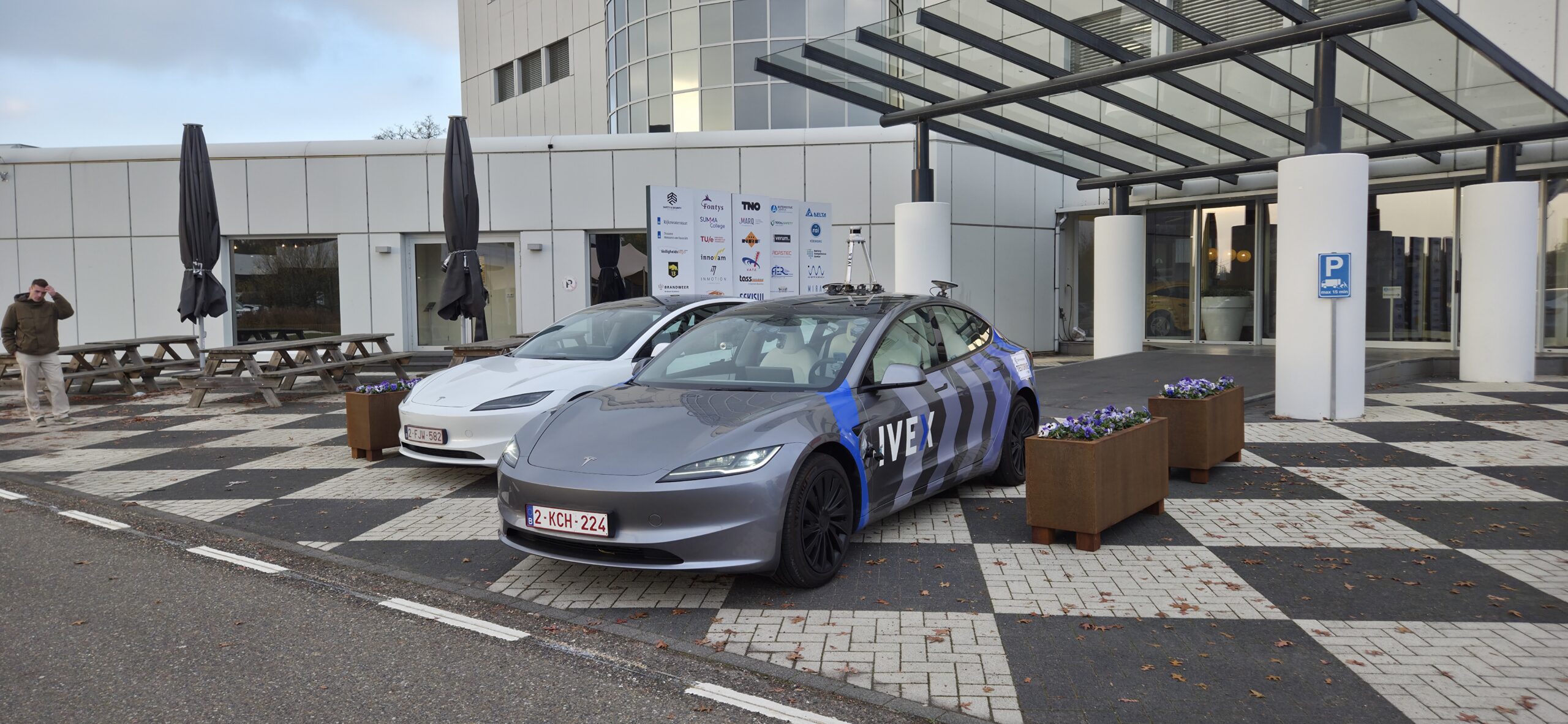
HASSELT/EINDHOVEN – This week, Tesla’s Full Self-Driving functionality is being tested on the route between Corda Campus in Hasselt and Eindhoven in the Netherlands. The tests form part of the CCAM project under Interreg Flanders-Netherlands, in which POM Limburg, the Roads and Traffic Agency, Flanders Make and imec are participating, alongside Dutch partners such as Brainport Development, TNO and the province of North Brabant. The test vehicles are fitted with additional cameras and sensors that meticulously record and analyse interactions with other road users and the driver themselves.
The trials are in line with the ambitions for broader cooperation between Belgian Limburg and the Eindhoven region. To this end, the partners signed a cooperation charter in which smart and sustainable mobility is one of the key priorities. Developments within the CCAM project are also being monitored as part of this collaboration. Steps have also been taken at local level: the municipalities of Lommel and Pelt have committed to supporting the development and testing of autonomous mobility in realistic traffic conditions.
Full Self-Driving
This week, a number of Teslas equipped with Full Self-Driving functionality are being put through their paces on public roads. The tests form part of the Interreg Flanders-Netherlands project CCAM Proving Region, which aims to test, improve and scale up smart and automated mobility across borders. The vehicles will travel from the Corda Campus in Hasselt to Eindhoven in the Netherlands. Testing is also taking place in the North Limburg border region and on the road to the Automotive Campus in Helmond.
The project partners are investigating how Full Self-Driving performs in realistic traffic conditions. To this end, the vehicle has been fitted with additional, high-tech cameras and sensors, both inside and outside the car. These record not only the vehicle’s actions, but also its interactions with other road users and the driver’s behaviour.
Tom Vandeput, Deputy for Economic Affairs and Chair of POM Limburg: “This is the first in a series of tests on public roads through which we aim to prepare our regions for the mobility of tomorrow. Thanks to the cooperation of municipalities such as Lommel and Pelt, we are also able to test new technologies in realistic traffic conditions.”
Cross-border challenges
The results and insights from the trial will serve as a benchmark for evaluating and comparing future autonomous systems. They will also prepare the region for the further digitalisation of mobility and transport. Particular attention is being paid to the complexity of border crossings, with the aim of strengthening the digital link between Eindhoven and Limburg.
“With the CCAM Proving Region project, we want to prepare our region for the mobility of tomorrow and develop it into a cross-border pioneer in autonomous mobility and logistics,” concludes Tom Vandeput.
