
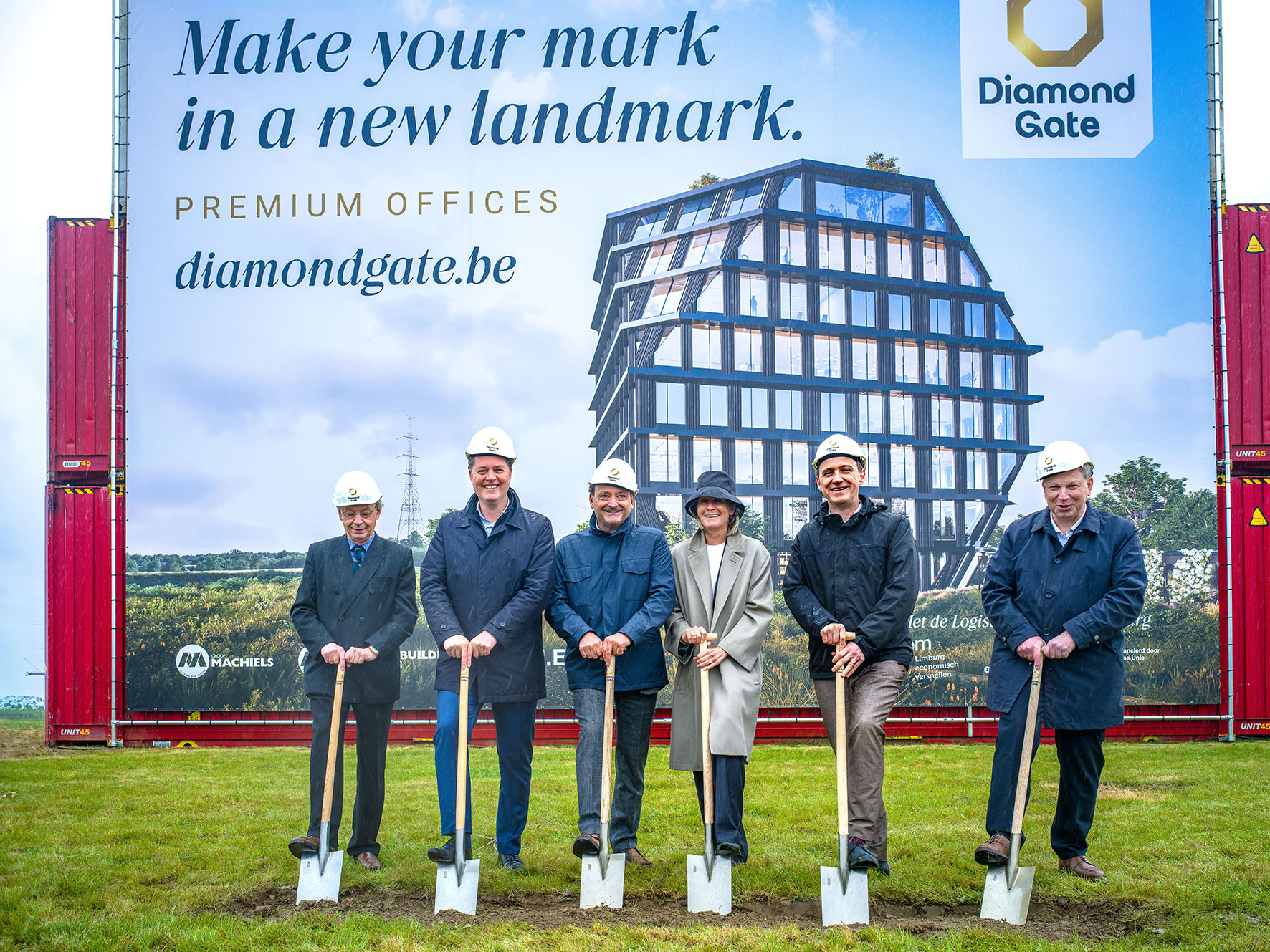
First Sod Turned for Logistics Campus Marks Final Phase of Ford Site Redevelopment
GENK – The first sod has been turned today for Logistics Campus Limburg on the former Ford site in Genk. With the planned gateway building, Diamond Gate, the redevelopment of the former car factory is entering its final phase. Over the coming years, a gateway building for the campus will rise on the last available plots of the site, where companies, researchers and public authorities will collaborate on logistics innovation.
On the 134-hectare Ford site, where cars once rolled off the production line, the area has evolved in recent years into a logistics hub with distribution centres, transhipment activities, transport and manufacturing companies. With Diamond Gate, the site is gaining a new face while its industrial history remains tangible.
The development of the Logistics Campus fits within a broader economic strategy for the region.
“The logistics sector is one of the key drivers of our economy,” says Tom Vandeput, Provincial Deputy for Economy and Chairman of POM Limburg. “Our region is strategically located between the seaports and the European hinterland. By bringing together companies, knowledge institutions and public authorities at the Logistics Campus, we are strengthening Limburg’s logistics assets and preparing the sector for the future. This project also fits within the further rollout of the SALKturbo strategy, the economic future plan developed for Limburg after the closure of Ford. Giving concrete shape to ecosystems through economic campuses contributes to higher added value and strengthens our economy in the long term.”
“Where thousands of people once worked in the automotive industry, we are now continuing to build the economy of tomorrow. With Logistics Valley Flanders, we show that Genk continuously reinvents itself. This new campus connects entrepreneurship, innovation and talent development in a place with a strong history,” says Wim Dries, Mayor of Genk.
Gateway Building Along Henry Fordlaan
The gateway building will be located along Henry Fordlaan and close to the Albert Canal, the railway and the E313 and E314 motorways. This location makes the site easily accessible by water, rail and road.
The building will feature a rooftop floor offering panoramic views of the activity on the site. Around the building, there will be a green zone, including a rooftop terrace, a green first-floor area and a park zone partially accessible to cyclists and pedestrians. The eight-storey building will provide space for offices and a restaurant, which will be marketed by the developers, as well as the activities of POM Limburg’s Logistics Campus coordination centre.
Limburg Collaboration
The development of the gateway building is in the hands of a Limburg consortium consisting of Group Machiels and H.Essers, two companies that have long been active on the former Ford site.
“That’s correct,” says Louis Machiels, Chairman of the Board of Directors of Group Machiels. “We are pleased to now also play an important role in the construction and development of the sustainable and innovative final phase of the redevelopment of this site. The gateway building, which together with H.Essers we are further positioning as Diamond Gate, will become the landmark of Logistics Valley Flanders. In addition, the façade structure of Diamond Gate will be carried out by Machiels Building Solutions, part of Group Machiels and specialised in sustainable timber frame construction.”
Logistics service provider H.Essers also sees the project as an important step in the further development of the site.
“As the first investor on this site, we strongly believe in the potential of this location as a logistics engine for Limburg. With this landmark, we are taking the final step in the development of a future-oriented campus that brings together companies, knowledge and innovation. It will become a recognisable landmark reflecting our ambition to strengthen the logistics sector and anchor our region even more firmly within the European network,” says Gert Bervoets, CEO of H.Essers.
Construction works will start in 2026. The completion of the campus is scheduled for 2028.
Sustainable Design Choices
Sustainability plays a central role in the development. The building is being designed according to BREEAM Excellent standards, with attention to energy use, materials, mobility and water management. Renewable energy and water recovery systems will be used. The façade combines concrete with timber cladding and timber frame construction by Machiels Building Solutions. Circular applications are also being considered.
“The building will have a distinctive vertical design with a recognisable façade in wood, glass and metal,” says Dirk Engelen of Binst Architects. “The finish in charred wood subtly refers to the site’s industrial past and Limburg’s underground heritage, while at the same time giving the design a contemporary and sustainable character.”
Logistics Campus Limburg
The central part of the building will house the coordination centre of Logistics Campus Limburg. It will include a UHasselt laboratory with an R&D warehouse featuring applications focused on ergonomics and productivity, as well as a digital experience space and flexible work and meeting areas. POM Limburg’s Logistics Platform Limburg will also be housed there.
Financing
European support through ERDF (European Regional Development Fund) is being provided for the development of the coordination centre within the gateway building, supplemented by funding from LSM (Limburg Sterk Merk) for flexible business infrastructure. The total budget of €8.6 million for the coordination centre of the Logistics Campus includes €3.3 million in ERDF support and €2.5 million in LSM funding.